Sunday, September 23, 2012

David Evans' Strength Workout, 2012

Practicing balance is increasingly important.  
When I was younger, I never thought about maintaining strength. Indoor workouts were anathema; those who lifted were from a different species. Back then, strength was a natural result of doing all the things you'd ordinarily do, including the swimming, biking and running that defined my mid 20s.  I had plenty of strength and never really gave serious thought to where it came from.  Strength just was.

Fast forward two and a half decades and life is decidedly different.  For one, the strength I had then, especially the explosive, faster-twitch variety, began ebbing at least a decade ago.  For another, I now live in an extremely hot environment, one where workouts, if they are done at all, are very often done indoors.  Add to this mix the desire to remain healthy and strong and competitive and, well, you're headed to some changes in habits and attitudes.

No longer do I think of strength workouts as something alien and unnecessary.  In fact, I'd even go so far as to say that without a regular regimen of strength training, an Ironman triathlete in middle age is operating on borrowed time.  It could even be that once endurance is firmly established by one's 20s, that fitness components like strength, technique and coordination gain primacy.
I do this spinal rotation stretch in the morning and before every workout.  I love it and consider it to be my own private mini-chiropractic adjustment!  For maximal benefit, be sure to breath deeply and relax.
Keep front lower leg perpendicular.  15 lbs/hand.

 When training for Ironman, my usual strength workout regimen included three strength workouts per week.  These lasted about 35 - 45 minutes each and focused on the muscle groups you see highlighted in this entry's pictures.  The more intensely I trained, the more I began to realize the crucial role played by strength training.  Concerted hours swimming, biking and especially running have meant a body weight in the 150 - 153 lbs. range.  As an Ironman approaches and volume begins peaking, my body weight can dip below 150, at which point I'm more susceptible to injury.  Perhaps equally important, a lower body weight can lead to a lack of strength down the stretch in the marathon.  A pure marathoner is lighter than a triathlete doing a marathon, and because the Ironman triathlete's competitive day is a lot longer, holding onto strength in the latter stages of the race is key.  This is where strength training can reap huge dividends.  
Exhale during contraction.  Slower is better with lifting.

Before strength training, be sure you are warmed up and that your muscles are ready for the flexions and extensions demanded by the workout.  Avoid jumping right into a strength workout without taking at least a few minutes getting the major muscle groups warmed up and ready to go. 

By the same token, be careful about tackling a strength workout after your muscles are tired.  Especially middle age, tired muscles can be less flexible and therefore less capable of delivering the energy loads and ranges of motion the workout demands.

25 lbs./hand.  Don't drop arms below this level.
 In general, use free weights if you can.  Free weights force the body to be more coordinated, and allow you to see if there are any asymmetries to your strength development. 

Focus on lighter weights at higher repetitions.  To the right, I'm doing these military presses with 25 lbs. in each arm, 15 reps at a time, two times per workout. 

Warm up with legs together on this one.
 In 1989 I was the top Manhattan finisher in the NYC Marathon, running a 2:29 PR which provided aspirations of running even faster at Boston the next spring.  Unfortunately, though perhaps predictably, I was also in my late 20s - the perfect time for tired connective tissue to make itself known.

Suddenly, my Achilles tendons were sore and tight, and the pain seemed to not want to go away.  In retrospect, I now see that I was lacking a coherent system of strength and flexibility training.  The years of running (by then 20,000+ miles in total) had taken a toll and, well, the Greeks had it right with my chain's weakest link.

Mostly by giving up on marathoning in '91 and getting involved with Nordic skiing and other non-percussive sports, I eventually made peace with my Achilles.  However, getting back into the Ironman meant that my now-even-older Achilles tendons needed TLC.  This exercise (above left) helps maintain strength and flexibility.  15 reps/side, fully up and down, with weight on ball of foot.  In part due to the dictates of weather, I also did about 85% of my total running mileage on the treadmill, which seems to be a much more forgiving running surface for the Achilles than pavement. 
Have the free arm pivot through 180 degrees.


Good spinal rotation forms the basis of much health and is the linchpin to a strong freestyle swim stroke.  This exercise (right) starts with the load-bearing hand fully extended forward, the feet placed about three feet apart.  I do 15 reps on both sides, 35 lbs. at a time.

This is a great core workout, especially if you focus on driving the rotation with your abdominal obliques and your thoracic carriage muscles.  A bit like pull-starting a lawn mower engine, this exercise gives a full-body workout.

Focus on the full range of motion; however, be careful not to retract the pulling arm to far behind the body.  


The free arm (hidden) pivots around body during rotation/contraction.
 I go from one station to another in fairly rapid succession during a strength workout.  Remember, you are an endurance athlete who should be very comfortable with an elevated pulse, so don't be afraid to march through the workout.

On the other hand, once there, slower is better than faster.  Focus on full ranges of steady motion, less weight rather than more, more reps rather than fewer.
Done well, this is harder than it looks. 

This abdominal workout is becoming one of my favorites.  For one, it really focuses on the core.  Yet it also demands balance and timing, and the bonus is that it helps loosen up and realign the back if you do it correctly!

Find a flat, stable bench.  I use a ball weighing anywhere from 6 - 8 lbs, placing it centered against the chest.  Extend the elbows out to the side, legs up, with lower legs at or near horizontal.

Focus on full rotation of the upper torso, all the while keeping your lower body still and in the position noted.

 
Keep feet together and still.  Focus on full rotation.
As with all good strengthening exercises, balance is key with this one.  Again, I do 15 reps (back and forth being one rep) twice during the entire workout. 

These little medicine balls are great for strength growth in general.  I sometimes throw it up in the air and catch it as a means of improving general strength.  Can also be done with a buddy.

I rarely do "traditional" sit-ups anymore but, thanks to this kind of strengthening, feel that my abdominal muscles  remain strong and flexible.

Breath out on the way up.  Strive for symmetry in the arms.
The bench press used to be the be all end all of lifting when I was a kid.  I'm sure its importance was overstated then, but that doesn't mean it shouldn't be a component of your overall strength workout when you're beginning your sixth decade of life.

I've got 25 lbs. in each arm, and I'm focusing on slow, steady, and symmetric movements as I go from (left) full extension to (below) contraction.


Some studies have shown that once you reach 40 you begin losing about 1% of your muscle mass per year.  Many adults begin noting that metabolism drops off about this age, and that they can't eat as much without weight gain.  By strengthening your body and maintaining your muscle mass, metabolism gets a boost.

Don't let your upper arms drop below horizontal.
Avoid holding your breath on this one.
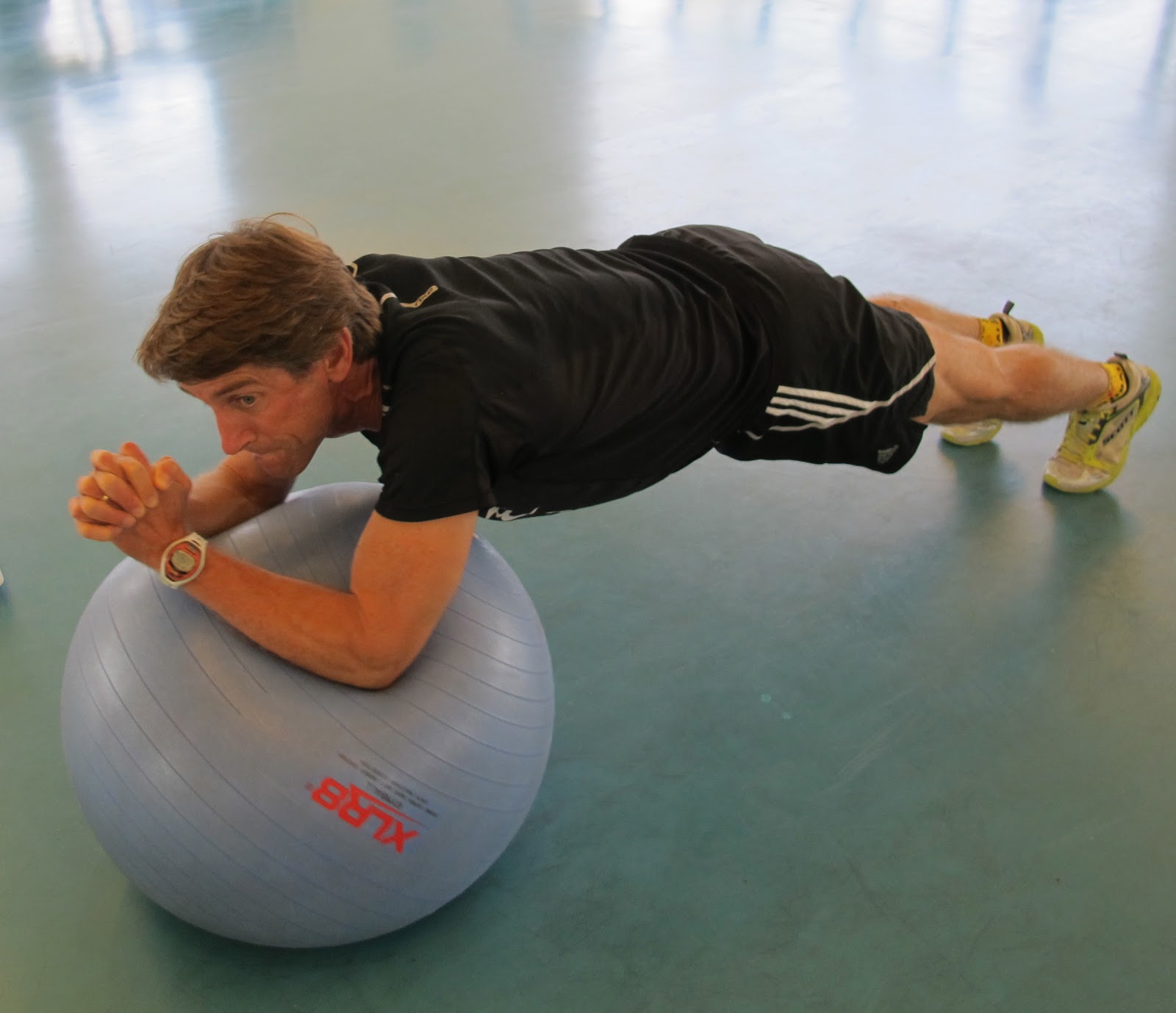
 This (right) is quite a difficult exercise and must be done carefully.  Here are the keys:
  • Don't let your butt drop below a slight elevation, as shown.
  • Place feet about a foot apart.
  • Rotate elbows in circular motion while keeping them in position shown. 
  • Exercise ball should be slightly under-inflated and not too big.
  • Keep breathing!
Strength comes from the core.  This is a good one.


This is a variation on the theme of the sideways plank, with a greater emphasis on balance.  Here is what to focus on:
  • Keep extended arm above the body and in the plane of the legs and lower arm.
  • Don't let the hips drop.
  • The weight-bearing upper arm needs to be perpendicular to your body.
  • Find your balance and get the body still before beginning your reps.


  • You can do a regular plank with upper leg resting on lower leg.
  • Or you can raise the upper leg a bit and create an isometric contraction, highlighting abductors.  
  • Best of all, this is a great way to gain range of motion and strength by raising and lowering upper leg through the full range.
  • I have ball rest against the wall, but if you're brave you can have ball be free...
  • Again, body position is important, so use mirrors or others' feedback to keep you honest.  
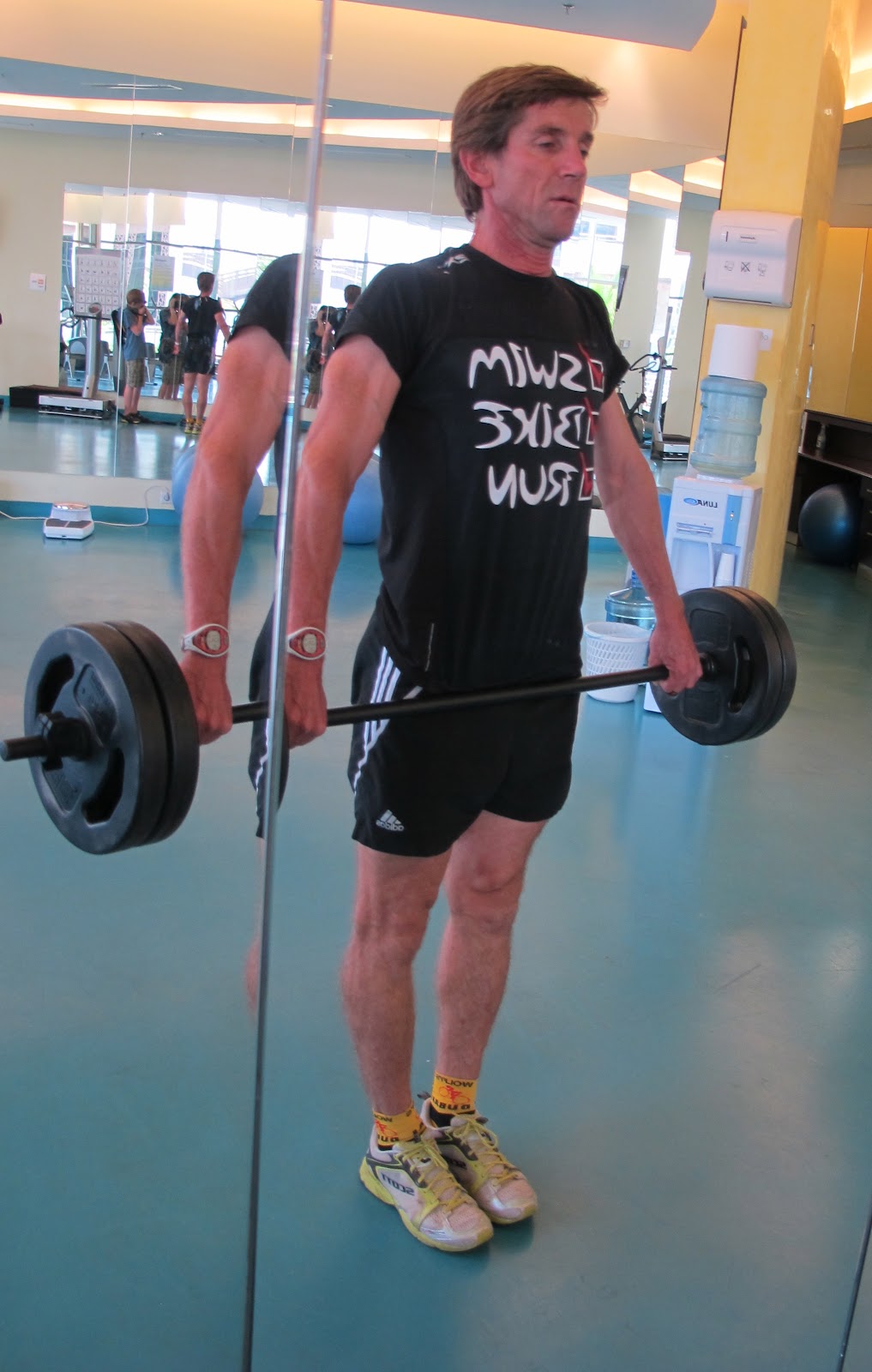
Bend at the hips, keep legs straight.
This one is my most recent addition.  It's a dead lift, with straight legs, that focuses on the legs of the back leg, particularly the upper hamstrings and gluts.  After a few hours of the bike leg's TT position this exercise helps maintain strength and power.  


Friday, August 24, 2012

Lance Lanced - Thoughts on Doping

We like to believe, need to believe, especially when it comes to our champions. And no one, arguably, was a more iconic champion than Lance Armstrong. At least up until today, August 24, 2012.

Lance seemed to transcend sport. Precocious, brash, but above all immensely, often scarily talented, Lance seemed to defy all odds. If cancer was racking half his body, well, he overcame it, even if it meant nearly killing himself in the process. You see, he'd been defying odds all along.

If 15 year-old Lance got out of the water with the top pros in the triathlon, then he full well expected to stay with them on the bike. If 18 year-old triathlete Lance decided to have a go at the national championships in cycling, then he didn't expect to just hang with the pack at the front, he made a pack of one off the front and broke away in what would become typical Lance fashion. If 21 year-old now-only-bike-racing Lance took on the best in the world at the world road racing championships, he again expected, and achieved, audacity, even if the day's cold numbing Oslo rain might seem anathema to any other boy from Texas.

And, well, there were the seven Tour de France victories, the Olympic medal, the other accolades and victories too many to recount here. And let's not forget the books that gave the laymen, so removed physically and emotionally as mere mortals must be, intriguing insights into Lance's world, the foundation he started and which is nearing a half a billion dollars in raised funds to fight cancer.

Yet somewhere along the way, and probably longer ago than many of us can appreciate or care to know, Lance got lost. Fractions and smidgens can separate great performances; truly great champions are expected to win their competitions, especially when they're close. No one knows this better than the athletes who delight us with these infinitesimal gradations, often day after day, year after year, preferably at the top of the podium waving the bouquet and kissing the young ladies.
  
Obviously, there will be much speculation about the whys, whens, and hows of this sad tale. Was it after the fight with cancer, once he'd already stared death in the face and made it blink first? Did he feel that his new, slimmer, lighter body needed that extra edge to win the only race mere mortals care about when it comes to bike racing, the Tour de France, a race he'd never come close to winning before cancer? Did he feel that the poisonous cocktail of drugs and chemotherapy was already more than anything EPO and its chemical brethren could deal him? Or was it before that, perhaps at the behest of an older and cynical cycling curmudgeon who'd not been able to make it clean himself and figured, perhaps naively, that teenager Lance couldn't either? Was it that Lance, lacking a father, and perhaps craving a male mentor, and wanting to be accepted and included in his new-found sport of cycling, obliged a stronger, established rider on the US team and began a long and complicated journey most of us are only beginning to fathom today? Or was it even before that, which is to say before cycling alone dominated his life at 17, going on 18, when Lance was a triathlete in his mid-teens, when he was especially young and impressionable and yet already, clearly and unusually talented? 
  
If so, he would not have been the first triathlete to dope.  Scott Molina failed a post-race drug test in Nice, France, in the mid-80s and then was banned for life from the Nice race, at the time, along with Kona, one of only two standout races in the young sport. We know that Lance had access to this coterie of triathletes of which Molina was a leader and growing legend. Was Molina part of a larger performance-enhancing drug culture in triathlon? No matter, was Molina an early and poor influence on Lance? We may never know. 
 
Testing was all but non-existent in those early days of the sport. I know I was never tested, then or now, despite dozens of triathlon wins and Kona podium finishes in 1984 and 2012. Even today, and despite all evidence to the contrary, testing is shoddy at best. As the New York Times and other reputable newspapers reported just this summer, doping is alive and well in age group cycling. It doesn't take a huge imagination to extend doping's reach into a sport that requires similar athletic talent and even more training time and commitment.
  
No matter where Lance's ethical fork in the road occurred, whether during his triathlon or cycling years, he knew doping had to remain out of the script, tacit to all who knew cycling for the distorted beast it had become but never admitted to a naive lay public that wanted its champions served up readily, with a plot line easily understood. It was a well-worn path of a lie others before him knew well; it was a falsehood Lance was apparently only too willing to subsume as a means to cycling immortality.
  
Instead, immortality has given way to ignominy, fame to infamy, and again we are left scratching our heads and wondering, sadly, for what might have been.  

Friday, August 10, 2012

Many key ingredients in an athlete's life can lead to lifetime competitive success.  Surely, biology plays a role, but since it's pretty tough to choose your parents, altering their chromosomal impact remains (at least for now) the stuff of fiction.  When it comes to things we might modify over which we do have some control, most aspiring athletes seek answers through changes in things like riding miles, stroke technique, running shoes, or nutritional supplements - it's a very long list!  While improvements can come about through careful alterations to these sorts of things, an often overlooked area that can have a huge impact on athletic performance is just good ole lifestyle.

Lifestyles have changed rapidly in recent generations, and at no time has that change been more pronounced and accelerated than it is right now.  Technology is rapidly changing our world, and those with the greatest access to new technologies are arguably changing their worlds the fastest.  For a species that may have taken thousands if not millions of years to evolve, such rapid change can't be all good.  In general we are more sedentary than we used to be, have access to more food more often than we used to, are considerably heavier than we used to be and, because we tend to live longer, have more chronic diseases than ever before.  While it is easy to say that an Ironman triathlete's life is hardly in keeping with the norm - and almost by definition has to be otherwise - we are part of this greater, bulging, not so healthy world, and it affects us whether we like it to or not.

So here's my thesis: the results of a life lead fairly intentionally probably had a bigger impact on my recent return to Kona and a 5th place age group finish than did the specific training I did in the months leading up to the race.  Sure, the swims, bikes and runs helped get me on the podium once I was at Kona.  But what got me to Kona in the first place?  Or, looking back just a few months earlier, what allowed a 50 year-old American male to make a rapid and successful transition from mid-life to world-class?  No one factor predominates; in no particular order, these might be the underlying habits that paved the Road Back to Kona:
  • Avoid the car.  Better yet, if at all possible, since so many of us commute to our professional lives, combine your commute with exercise and bike commute.  I've never let a job tie me to the daily grind of car commuting.  Instead, I've used getting to work as a means of exploiting some combination of car-pooling one way and cycling the other, bike commuting both ways, taking public transportation- bus, subway, ferry - and using the connecting walks/rides as exercise.  Of the more than 100,000 miles of riding miles in my legs, my nearly 20 year-old commuting bike can claim nearly 50,000 miles of them.
  • Avoid "labor saving devices."  Use a push mower.  Wash dishes by hand.  Knead your own bread.  Chop your vegetables.  Rake leaves.  Sweep with an actual broom.  Essentially, do your best to make your body the power source so often provided by engines.  This past summer I gave a short talk at my 30th Carleton College reunion on the importance of an active lifestyle.  We've allowed technologies and other putative conveniences to mortgage our health and consign us to the sofa.  Instead, stay more fit by reclaiming your active self.     
  • Avoid the car again.  If it's true that at any given moment most cars are within five miles of home (and I'm told it is), then by extension it must be true that many if not most car uses are at least arguably unnecessary.  The bike remains the workhorse of the world because of its utility, efficiency, and comparatively low cost.  When we lived in the Ballard neighborhood of Seattle, most all of our errands and quick trips were done by bike, even though we owned a car.  A willing pair of legs, a good set of panniers, and even a trailer, can alleviate the need for a car just about every time.  Make the bike the go-to vehicle, not the car.
  • Keep your weight steady.  Through good genes and, increasingly, careful habits, since 1980 when I stopped growing, I've been able to keep my weight a fairly steady 155 lbs., +/-2%.  By avoiding mindless snacking, eating only when hungry, keeping the diet balanced and, above all, maintaining an active lifestyle, body weight tends to fluctuate less.  If recent studies are correct, and it's the sometimes tremendous fluctuation in weight that comes with the weight gain/weight loss cycle that is unhealthy, then keeping your weight steady is a doubly good thing.  Additionally, maintaining steady weight and a good Body Mass Index allows a person to more readily transition back into serious sports with fewer health risks.
  • Stay strong.  After 40 years of age, most males begin losing about 1% of their muscle mass per year.  Being active and fit can surely help forestall some of this normal pattern in aging, but the truth is that the seemingly automatic muscle strength and tone of the late teens and twenties becomes more and more of a rarity as we get older.  That said, I decided early on in my Road Back to Kona that I'd make a regular core exercise and strengthening regimen part of my overall training game plan.  In part, living and training in Saudi Arabia like no other Kona-bound triathlete was, I knew that I'd be spending a fair amount of time indoors anyway due to summer conditions leading to October's Hawaii race.  But, like it or not, I also knew that I just wasn't as strong as I had been in my 20s and that, unless I wanted to increase my risk of injury, once the training volume started kicking in I'd better complement the tri-sport component with careful attention to strength, flexibility, coordination, and even balance. 
  • Don't overtrain.  I'm old enough to remember the days of wanton over-distance training.  Sadly, it was a distance-addicted cross country running coach who turned me off to collegiate running in my first months of college in the fall of '78.  One week my mileage topped out at 128 miles - and I was just 17 years old!  The previous season, in high school, I'd maybe been running a third of that mileage; the change was just too abrupt.  Probably from that moment onward, I gained a healthy distrust of adding mileage for no real reason other than bragging rights.  Even in the '80s when I won two dozen triathlons and placed 7th in the Hawaii Ironman, my mileage was always embarrassingly puny compared to those of, say, Scotts Molina, Tinley, and certainly Dave.  Being in graduate school during those years was a tempering influence to mindless mileage and overtraining, but there is possibly no greater antidote to over-training in one's mid-life than being a husband, father and full-time teacher.  Rather than worry about training too much, quite the opposite is true when sports take a back seat.  When I look back on my Road Back to Kona training log and add up the entries' hours, I'm pleasantly surprised to see that high volume weeks topped out at 15 - 17 hours, nothing more.

   Other non-swim/bike/run factors certainly played a role in my Road Back to Kona, but the above six represent the most significant ones.                  

Wednesday, June 13, 2012

1984 to 2011 - A Retrospective


When I first met my wife 20 years ago, doing another ironman was about the furthest thing from my mind. Pretty much as soon as I’d gotten out of Kona harbor in October of ’87 I’d gone cold turkey with swimming, which had been my weakest event in any case.   And, except for commuting on a mountain bike, I had a road/TT bike that collected dust. For a decade, I did refocus on a passion for running, but even that got old as my body began telling me that other activities made me feel better.

Over the years, students and athletes who knew of my triathlon background would sporadically tell me of TV coverage of Kona’s big October event or some other televised tri, asking me if I’d seen it.  But I never had, and so, for a number of decades, Kona remained well off the back burner of consciousness, a chapter in my life that seemed increasingly vague and unimaginable.

Whenever I pondered Kona and the lessons learned from three races there in ’84, ’86, and ’87, thoughts inevitably returned to ’85, a race I didn’t even do.  It seemed strange, but the more I tried to put that chapter of my life behind me, the more those pages’ unwritten paragraphs spoke to me.  Folks often asked about the ’84 race, but to me the ’84 race lacked punctuation, an incomplete sentence that suggested and implied, rather than clearly stated.

So the ironman remained, outwardly impressive bio in most people’s eyes but inwardly a question mark, a silent, relentless siren song that only I could hear.  I knew that in ‘84 I’d beaten Chris Hinshaw, the following year’s second place finisher, and that during the ’84 marathon leg I’d been gaining on Mark Allen and John Howard just ahead of me in 5th and 6th place, especially in the latter stages.  But, as I learned with perspective gained only with time and reflection, ’84 was more broadly special as well.   

’84 was the first time Kona was won in under 9 hours – Dave Scott.  The first time a runner broke 3 hours – Dave Scott.  The first time cyclists broke 5 hours – John Howard and Mark Allen.  The first time a swimmer broke 50 minutes – Chris Hinshaw. The stars must have been aligned that day, since it was also the hottest day on record for a Hawaii ironman; little wonder that it also has one of the highest drop-out rates on record. Four of the top six males in the ’84 race represented 15 past, present or future Kona race victories and countless other triathlon titles. 

Among the top group that day was Dutchman Rob Barel, certainly a harbinger of top finishers to come as the only non-American of the bunch.  Rob would deftly bridge the early world of triathlon with the approaching new millenium by staying amazingly fit and fast, competing 16 years later in Sydney - in his’40s - in the first Olympic triathlon.

Not to be outdone, unknown to most that day was a young guy out of Pennsylvania by the name of Kenny Glah, who finished the first of what has now become 28 consecutive Hawaii Ironman World Championships, an unbroken string of Kona races that no triathlete will touch for a very long time, if ever.

Yet ’84 was pioneering in another way as well since, on that day, the triathlon’s top-dogs apparently realized that in order to keep billing itself as the “World Championship,” a trophy and a handshake would no longer suffice.  No wonder then that ’84 was the last time so much triathlon talent was ever assembled to race an ironman without the possibility of financial reward.  Voting with their feet, fully 75% of top-8 from ’84, including icons Dave Scott and Mark Allen, chose to not participate in ’85.     

On perhaps no other day than October 6, 1984 had the then young sport matured so quickly and begun to define itself so clearly.  And yet in ’85, when I might have been showing folks that ’84 hadn’t been a fluke, I was instead watching race coverage from my living room, happy for Scott T., Chris H. and company but wallowing in a bit of self-pity.  Earlier that year a reckless driver had sent my rear derailleur through my right leg as her car crushed my bike and sent me flying like a rag doll down the country road.  I knew I was lucky to be alive and fortunate to have had successful surgeries and physical therapy, but the competitor in me was heartbroken. 

In ’86, racing again, I was named a member of a four-man U.S. team in a new national team division at Kona, but I put too much pressure on myself to repeat ‘84’s performance and ended up a DNF.  By ’87 I’d finished my graduate work at U of Michigan and was about to enter the full-time workforce, but Kona’s allure snared me one more time.  I finished, knowing that I had to, in almost exactly the time I’d posted in ’84.  But I’d been through too much and my heart had moved on; the ironman, and Kona in particular, no longer pulled on my heartstrings. 

Which is why it was easy for me to promise my new wife in the early ‘90s that I’d never do another ironman.  Never. Less than two years ago, now living and working overseas, my tune still hadn’t changed.  Sure, I’d lived a life of fitness, which included cycling, the less and less frequent swim, and the much less frequent run, but the idea of putting all three together again, especially over such a great distance, just didn’t compute.  Besides, I had a wife, a family, a full-time job, other interests.

 And then the emails began coming from a former training partner who’d fallen hard for triathlon while living in Sun Valley.  We’d done plenty of ski and adventure races together in our families’ shared decade in Seattle, and, knowing of my Paleolithic tri-sport past, he began sharing opinions about his newfound endurance sport love, occasionally asking for advice.  True to form, he rocketed to the head of the class, easily qualified for Kona and, soon after his maiden journey down Ali’i Drive, was wondering if I’d care to meet him in 2011 at the pier.  Naturally, my first thought was about ’85 and the race that wasn’t.  Our exchanges had blown air on the embers of the subconscious; suddenly, I began asking myself the “what ifs” that so often preface life’s big decisions.   

Some guys’ mid-life crises involve fast cars; I got triathlon’s equivalent by updating my road bike by 25 years and purchasing the kind of TT bike I’d only seen in Tour de France coverage.  Meanwhile, it took me three weeks to finally get up the courage to ask my wife if I could dedicate nearly a year at 15+ extra hours a week to a triathlon renaissance.  She appreciated the barrenness of our university compound life, knew that I was about to turn 50, and had come to make peace with her husband’s lifelong love affair with sport.  I promised to do as much of the training in the wee hours of the morning so as not to disrupt family life too much.  And, once I added up all the many costs of re-entering a sport that had gone from pricey to exorbitant, I also vowed that it’d be a one-time deal: October 2011, full stop.  Besides, teachers are generally very busy in October, and I’d been lucky this time to have a school give me the time off for both the April qualifier and the October granddaddy.

27 years is a long time between podium appearances at Kona, perhaps a longer time than any other triathlete can claim.  The world wars were closer together.  Having already experienced the good, the bad, and the ugly at Kona, I knew to take nothing for granted this past October.  The racecourse, the competing athletes, the town, the body - all had changed over the years.  But one thing was for sure: I still loved racing and was determined to fully enjoy this reprise.  In the end a 9:50 fifth place age-group finish was less than seven minutes or about 1% slower than the 9:43 I’d first posted in Kona in 1984 at the tender age of 23 when 10 bananas, a couple gallons of water, and sheer youthful exuberance and naivete had powered me all those 140.6 miles.

It may be a long time before I return to Kona, if ever.  But yesterday, in reading about a 74 year-old Spanish climber who is attempting to become the oldest person to scale all the 8,000m mountains and who has maintained a life of steady fitness to get where he is today, I realized something: I’ve always wanted to be like these kinds of guys.  In fact, given that it was 24 years since my last Kona race and that in 24 more years I’ll be 74, I just may have to think about Kona again in a few more decades….  

Thursday, June 7, 2012

Musings of a Teacher/Triathlete

Teachers don't have it easy.  Crowded classrooms and unruly students may challenge some, but if you're a teacher, like millions are, and a triathlete, like thousands of us are, with aspirations of making it to Kona for October's big event, like hundreds have, then you face an uphill battle that makes getting up to Havi a walk in the park.
For starters, of all the possible months in which to hold the Ironman World Championships, from a teacher's perspective, October has to be the worst.
June - August typically contain some variation on summer break, September has Labor Day and its extended weekend, November has Thanksgiving, December/January have Winter Break, February often has Mid-Winter Break or Washington's Birthday, March/April have Spring Break, and May has Memorial Weekend.  What does October have?  Halloween, a workday filled with unusual fashion choices and amped up sugar intakes, but no time off.
Of all the possible months, that fateful decision in 1982, when the Hawaii triathlon powers that once were moved the race from February to October, arguably impacted teachers the most.  Unlike folks in other fields of work and psuedo work, a teacher's "time off" is programmed.  Even in the southern hemisphere, my South African teaching colleagues attest that October is a busy month, as students are ramping up for exams and summer break.
So what is a teacher with dreams of making it to Kona to do?  Well, when I qualified this past year, I had to negotiate time off and begin planning for subs for classes well in advance.  I sat down with my school's principal and superintendent early, months before the qualifier in Port Elizabeth, and talked through the whole plan: going to Abu Dhabi in March to shake off the cobwebs of a 24-year retirement from serious triathlon, then trying to earn the single 50-54 age-group Kona-qualifying spot in April at Ironman South Africa, then, if fate would have me, going to Hawaii in October for the world championships.  I'm fairly sure that they felt they were risking mainly having me gone a day for Abu Dhabi and a few days for IMSA, which conveniently backed up to our Spring Break and therefore meant I didn't have to miss very many days with my students.  Let's face it, as any who have recently tried to compete at Kona well know, the odds of my making it were not good.
However, when IMSA went well and I'd qualified in my first attempt for Hawaii, the first time since 1987, I scheduled a follow-up conversation to remind them of the original plan, however hypothetical it may have seemed at the time.  I waited one week, then two, for their response and final okay, and meanwhile I'd recovered and begun tentatively training for Kona, still not knowing if all the hard work and planning would actually lead to the road back to Kona.  Finally, after what seemed like forever but which was actually less than three weeks, I received word that I could indeed go.
There was just one hitch, of course.  However frugally, I'd had to update my vintage 1980s triathlon equipment in order to even have hopes of competing on the more crowded and talented 2011 triathlon playing field, and I'd been a teacher my entire professional life (and was therefore, unlike a number of my fellow competitors at Kona, was not independently wealthy).  So, just like each of the preceding five days off I'd recently taken, the ten days I'd need to travel the 13 time zones to and fro where I currently live and work and compete at Hawaii's Ironman apparently would be unpaid.
A number of folks on campus tried, ultimately unsuccessfully, to get me some level of sponsorship from the folks at the top here. I tried to lobby upper administration and make the experience part of our students' learning, potentially connecting learning to a teacher's somewhat unusual and arguably interesting non-academic life, but this too proved to be a non-starter.  Then, with only weeks to go before having to leave for Kona, a vocal group of supporters on campus tried to pitch my quest one last time to the upper campus administration.  For a time it seemed like the impasse would be overcome, but then, only days before boarding the plane, I again found that financial help would not be in the cards, that no one wanted to take on the hot potato of sponsoring an employee while having to answer to potential auditors later on, or at least that was the whispered claim.
If you include the past year's three race fees, the travel, the accommodations, the food, the essential equipment, and the lost salary, competing in Kona in 2011 cost more than all the more than three dozen triathlons I did from 1984 - 1987, and that includes three trips to Kona in '84, '86, and'87!  To be frank, some of those '80s races had at least some expenses covered by sponsors.  But most of my expenses back then were covered by me, and to keep expenses down while in grad school at Michigan, most of the races I did were local, or at least regional, which meant I didn't usually have to fly to races.
Still, the widening gap between the sport's financial demands and what increasing numbers of folks modestly possess as discretionary income is balkanizing a sport already regarded as elitist, seemingly inaccessible.
So there I was at the awards ceremony in Kona, my last night in Hawaii, and just by chance I had sat down at a table that included two other teachers.  Excitedly, we compared notes and talked about the amazing week we'd just had.  One guy, currently teaching in Dubai at an international school, had rallied the school community behind his quest and was getting full pay while being gone.  Meanwhile, farther down the table I later met a woman, teaching in Europe, who not only was getting paid but had attracted sponsors, one of whom had paid her air-fare and another of whom had helped her with what all of us know are considerable bike expenses.
And there I sat, disconsolate, shaken, a bit upset even - until the awards were announced - when I realized that no amount of money can compare to being able to mount the podium at a world championship one more time, especially more than half a lifetime after the first and only other time I'd been on the podium, in '84.  Knowing that I'd financially done it all on my own, this time against tremendous odds, gave pause for special thanks to family, friends, and teachers and coaches, some long-ago, who'd first inspired and tirelessly supported.  And I reminded myself that as a teacher and coach, part of my compact with my student/athletes includes planting that seed of possibility by nurturing potential.  My only hope is that if I ever have students able and willing enough to fully embrace this amazing sport of triathlon, that finances won't prove to be the one finish line too far for them to reach.         


Friday, May 11, 2012

Adversity Meets its Maker

The first time I competed in the Hawaii Ironman Triathlon World Championships, back in October of 1984, I had a broken leg. Not completely broken like a compound fracture, but broken enough to be a sizable stress fracture and therefore easily noticed by a radiologist five months later, after a reckless driver doing 50 mph hit me from behind, sending my rear derailleur machete-like through my lower leg and breaking the leg once again, thereby necessitating an x-ray or two.

I can still remember the radiologist's incredulous expression when I told him I'd just finished 7th in the world in the Hawaii Ironman, explaining, delicately and even a bit sheepishly, that an Ironman triathlon consisted of 2.4 miles of swimming, 112 miles of cycling, and 26.2 miles of running. In the weeks leading up to Kona I'd noticed increasing tightness and uncomfortableness just below the patella. Twenty-three years old and naive,  I took this inconvenience merely as a sign to start tapering, which I did. When the radiologist added, "You know, from the looks of this x-ray you're damn lucky your leg didn't just snap out there during the marathon," I realized that attempting two Ironman distance races in the space of three months, which I did between July and October of 1984, was both brash and foolish for my then young, low-mileage body.

In 1983 the folks in Hawaii had rejected my application to compete, even though I'd gone undefeated in a series of triathlons that year and had also won the Michigan State road race for cycling and competed in the USCF Road Race Nationals in San Diego. So by the fall of '84 I was rearing to go and compete in a race about which I'd heard so much, a one-day event that was then, and now, the Mother Of All Triathlons.  I felt I had the mettle to compete at the highest level in the sport; perhaps more significantly, I was still licking the wounds of rejection from '83 and wanted nothing more than to show the Hawaii Ironman folks that they'd made a mistake the year before by not allowing me to come to Kona and compete. In retrospect, I'm fortunate not to have been carted off in an ambulance with a compound fracture of my right tibia. The leg more than held up - moving me from 13th off the bike to 7th by the end of the marathon, and even gaining on Mark Allen (in 5th) and Jon Howard (in 6th) in those delirious final miles - but I was extremely lucky. And I didn't even know it.

Fast forward 28 years to this past October 2011, when I found myself again on the podium at Kona, this time with the 50-54 age group leaders. Six months later, which is to say quite recently, I'm told that I have thyroid cancer after a mysterious bulge starts appearing in my neck, is noticed by my vastly more intelligent and perceptive wife, and I dutifully get it checked out. When I ask a number of the attending doctors how long they think I've had the tumor, based on the size and details of the cyst, 2 - 3 years is their best estimate. Just two years ago places the problem before I even began dreaming of a triathlon renaissance, of getting back into "Kona Condition" and tossing the notion of middle age temporarily out the window.  I had cancer and didn't even know it.  I had a thyroid that wasn't working at all well - better than now, but certainly not as well as it's supposed to - and I just soldiered on, oblivious to the messages it was sending me, determined once and for all to show that '84 had not been a fluke.

As if getting to mount the podium at Kona isn't difficult enough, doing it twice, and despite the added hurdles of a broken leg and cancer, points to the immense power and pluck of the human condition while underscoring its considerable vulnerabilities and frailties. Or is it that a body subconsciously knowing itself to be on thin ice somehow wills itself to go to extremes to affirm its vitality?  If Kona's legendary race can be likened to an orchestral piece one might call "Variations on Accelerated Darwinism in Three Movements," then lurking subtexts like a broken bone or a cancer can only add to the overall human drama of the moment.  Events like Kona may also underscore our bodies' enduring resilience in the face of significant obstacles, and it may be the at-the-time unknown obstacles that are the most significant. Give an athlete a competition and he/she will race. Quietly tell his body that it's in TROUBLE and it may allow itself to go to unusual ends to maintain the game face on game day   

Hardwired to survive at all costs, some of our ancestors' descendents, including this author, even take comfort and derive confidence from the sort of pursuits that would simulate physical deprivations and challenges not unknown to our long-ago forebears.  While our prehistoric predecessors may not have been triathletes, their ability to overcome incredible adversity in their grueling, often ceaseless, quest for safe habitat and adequate food conjures images not dissimilar to those coursing through the psyches  of the legions of runners making the turnaround at the Energy Labs. And perhaps for some subset of those competing at each Hawaii Ironman, it may be when the chips are really down that the racer achieves her/his greatest destiny.

I've had the honor of competing four times at Kona.  Besides the two races mentioned above, I also raced in '86 and '87.  While neither of those races was accompanied by any mysterious plot akin to a fracture or cancer, it's also interesting to note that neither race produced a podium performance.  Of her sickly, accident-prone brother, my sister once said I'm a glutton for punishment.  Turns out, she (and we) didn't know half the story!

Friday, May 4, 2012

The Flipped Race

Back in the '80s, none of my triathlon buddies would have ever accused me of being fast in the water. Never a competitive swimmer while young, like most triathletes, I dipped my feet into the wet world of triathlon's inland lakes and ocean bays by learning how to swim competitively in order to be a triathlete. A land animal, my only hope in most triathlons was to get out of the water not too far behind the top dogs and try to bike and then run down as much of the competition as possible. This was a fine strategy in local and sometimes regional races, but it worked less well whenever up against the top talent. In Hawaii in '84, I had top 10 bike and run splits, but my swim time (57 minutes and change) placed me 72nd overall, more than seven minutes back on most of that day's eventual competition. Indeed, the more I relied on the bike and run, the less confident I became as a swimmer, especially in races against the best. And despite getting into the 54 minute range at Kona, my swim remained through my mid-1980s life as a triathlete a pale, some would say pathetic, pretender to the triad.
 
Twenty-five years later, now with 40,000 miles of running in the body and much of it done on hard surfaces, the body was less willing to run well in training, never mind far. In particular, chronically sore achilles precluded the possibility of training long or hard on hard surfaces. Sure, the body could still churn out a sub-18 minute 5K and get in the 3:35 range for the marathon leg of an ironman in a competitive moment when it had to. But the requisite proper training, especially for the Ironman distance, seemed out of reach, the 50 year old body variously unwilling or unable to undergo the training I'd remembered in younger years.

So, as I made the decision to Go For Kona in November of 2010, and given that I was training in Saudi Arabia, where you could go a lifetime and not see anyone running outdoors, the decision to complete most of the running training on treadmill, indoors, made sense, especially in the summer months leading to Kona, after I'd qualified in Port Elizabeth at Ironman South Africa. Treadmill workouts didn't leave me nearly as beat up and sore. They also connected me to a gym workout world that I'd always avoided but at 50, and losing muscle mass and flexibility, now needed.

Thus began a calculated decision, a risk really, to run sparingly outside while building the lion's share of base miles and eventual speed indoors on the treadmill. While I'd never even dreamed of this kind of approach before, over the years I'd read of a number of top runners who, for various reasons, had used treadmills in their training. Besides, my body and the local weather weren't giving me much choice; in the end, the decision was perhaps inevitable.

All told, about 90% of my running mileage took place on a treadmill. Going into IMSA last April, I'd run a dozen or so times outside, the longest of which was slightly over two hours and 18 miles in duration.  I had a good but not great run in South Africa yet knew that the stakes would be much higher in October. But the running road to Kona was more complicated, the half-century old running body seemingly less willing to abide long outdoor runs, in part due to our whistle-stop six weeks of traveling in the U.S. during June and July, when all training became catch-as-catch-can, and in part due to the insanity of training outdoors in Saudi Arabia most any time in August or September, once we returned.

Perhaps knowing where all this was headed, I focused where I knew I could and must: the bike, and especially the swim. The few swimming folks on our compound took pity on me. An Australian woman, already a swim coach on campus, met me regularly to deconstruct and gradually reconstruct my stroke, while an Englishman, and the only guy on campus who swims daily and well here, took apprentice-me on as a project, giving me the regularity of brutal interval workouts and the clarity of someone always just a bit ahead. Gradually, the swim came around, so much so that by the end of September I felt in as good a swim shape as ever, possibly minus a smidgen of the raw speed of one's 20s.

If anyone would have predicted my 2nd fastest swim time among the top 10 in the 50-54 age group at Kona this past October, just a few minutes slower than Krissy Wellington (who didn't have to contend with the age-group multitudes) land-lubber-me would have called them crazy! Similarly, if anyone would have said I'd run only the 7th best run split of the top 10, I'd have thought them more crazy. Yet changes to one's body during aging are difficult to anticipate; knowing how these changes will play out in the "Kona heat of competition" are even more difficult to predict.

Be that as it may, on October 8, 2011 I knew I'd be playing my two best cards on the swim and the bike, so it wasn't a tremendous surprise when I got off the bike in third and by mile 15 had moved up to second, less than 90 seconds back, and about 15 minutes ahead of my Kona PR pace from way back in '84. And then, perhaps predictably, the years of running, a 2:29 marathon PR, and a personal triathlon history of always moving up during the run met the mid-life reality of insufficient preparation combined with world class competition. Nine hours into racing, pedigree didn't matter, the auto-pilot of survival kicked in, and the late-race Darwinism of out-lasting others in the age group, all in similar stages of delirium, became the only imperative. That I was able to hang on for 5th place remains a mystery, just like life itself.  Okay, I suppose I should thank my swim!

The biggest lesson learned last October may just have been that in every one of us there is this tremendous ability to adapt in order to compete. I still wouldn't consider myself a swimmer per se, but I can say this recent flirtation with aquatic success has sparked a new interest in swimming on a somewhat regular basis, possibly as a cornerstone to a second half-century of healthy living. I may not love swimming the way I long first-loved running, but 31 years after completing my first triathlon I can now hold my head high in the post-race analysis, a bit amazed that for once it wasn't the swim that held me back!