Monday, February 25, 2013

Aging Triathlete - It may not be about the swim, bike or run

Aging is a complicated process.  While chronological age may be a poor indicator of actual ability, everyone ages eventually, even those top Iron Men and Women in Kona who get up on stage during the awards with those mind-boggling times and incredibly fit bodies.

In short order I will be 52 years old, and while that may not seem old to some of you, the increasingly youthful world in which I live tells me that I'm at least fairly old to most, and ancient to a few. 
Last weekend I was fortunate enough to be able to defend a cycling title for the fourth year in a row on our humble campus.  Even though I was older than I'd ever been, struggled through thyroid cancer this past year, and despite having a number of folks in the peleton whose age could make them sons of mine, I had the most convincing performance of the four.  Reflecting on the race, a few thoughts came to mind, and because this is a triathlon blog written by an older age-grouper, I thought I'd share them:
  1. If you've been a lifetime endurance athlete and want to stay fit and competitive, you've got to change your game as you age or else risk getting burned out or injured, or both.
  2. Endurance is probably something you don't need more of.  While you need to maintain it, and possibly hone it as race day nears, the endurance money is probably in the bank if you've been a serious endurance athlete anything like the four decades I have. 
  3. That said, the high miles and mythic intensities of yore need to give way to something else, something smarter, clever and more nuanced than anything you may have ever considered.  Performance needn't fall off, at least not dramatically, but strategies and mindset need to change. 
  4. I just posted a core strength workout.  For me, this component to overall health and competitive success is the biggest change to my regimen.  Swim, bike and run was pretty much all I did to train back in the '80s, my mindset then being that if those were the stages of this new race called triathlon, then what other way would you prepare than S/B/R? If the three sports carried me to 7th overall at the '84 Hawaii Ironman, then core strength carried me to 5th in the 50-54 age group in 2011.  Without it, I never would have gotten through the marathon, because I can assure you I certainly didn't get through that final leg on the running training I didn't do!  
  5. Flexibility is also more important than it has ever been.  I can remember being on the running teams in high school and stretching with the team before the "real" part of the workout began, wondering, probably like everyone else, why we were having to do all these dumb stretches.  Yet Coach Vann was a smart man, and the idea was planted, the ethic established, and over time I found myself working on my flexibility more than before.  Now, I stretch whenever I can - during meetings, while I'm typing this, when I get up, before I go to bed, whenever I want to relax - because I find that it makes me feel really, really good.  And because I know that it has allowed me to remain very competitive.
  6. Nutrition is a strange thing to mention in a way, since good nutrition should be a given in any serious athlete's life.  However, during my lifetime the average American male has only gotten heavier and heavier, while the food that he eats has gotten more processed, less wholesome. and evidently more plentiful.  Triathletes tend to be a fairly prescriptive bunch, but they're not completely immune to the world of alarmingly common obesity/diabetes/hypertension/heart disease/etc. in which they live.  I can still remember reaching 152 pounds as an 18 year-old in college.  This morning after my swim I weighed in at 152 pounds again, which was no surprise since I've been plus or minus five pounds from that weight for the past 43 years.  I admit it, I've been fortunate, I have good genes and have remained reasonably healthy and very active.  I've never gone for fad diets, and never bought into the latest this or that of nutrition gurus.  Instead, I try to avoid snacks, try to eat only when I'm hungry, try to eat a balanced diet that includes most anything, and rarely eat out.  I've learned to listen to my body when it comes to food and I find that it's pretty darn smart if my ears are open..
  7. Technique work is probably more important than merely more training, particularly as you age.  Remember, if you're an endurance lifer like me, you probably don't need lots and lots of miles in the pool, etc.  Instead, get some technical coaching and retool your techniques, because the old dog can learn new tricks.  Before Kona 2011 I knew I wasn't going to be able to run as many miles as I'd hoped (feel free to train in Saudi Arabia in June, July, August and September!) and would therefore probably not be able to rely on the old trump card of a fast marathon.  Consequently, I reconfigured my approach to the race.  Rather than saving the best for last, which I knew wasn't going to happen, I decided to go after the swim and bike and then do my very best to hold on in the run.  Since swimming had traditionally been my much weaker leg of the three (in '84 in Kona, for example, I had top 10 times in both bike and run), making it the prima ballerina meant that I needed to do some serious reworking of my swim technique, and attitude.  I worked with a number of different folks, completely reconstructing my freestyle technique and mindset in the process, and in the end had easily the best swim performance relative to my competition of any of the four Hawaii Ironman I've competed in (2nd best out of the top 10 in my age group).  And it didn't end there.  Now, even when I go swimming with no looming competitive goal, I love to swim and think of myself in no small part as a swimmer.  This is a profound change in my sense of self as a triathlete, and it probably saved my podium finish down the stretch in Kona.
  8. Context is key as you get older.  By that I mean, sure, be competitive and go for as good a performance as you are able to, but do it within the personal, professional and logistical context of your time and ability.  When I first went to Kona in '84, triathlon was all I thought about, all I wanted to do and pretty much did do.  I had no wife, no kids, no job to speak of.  Although I was in graduate school at the University of Michigan, my part-time student status was expressly designed to allow me to train and race to my heart's content.  Fast-forward nearly three decades and wife, children, friends, job - you name it - can make training and racing take a quick back seat.  Legion are the cautionary examples of older triathletes who lost jobs, or marriages, or health, or variations of all three, in their quest to make it to Kona.  Be sure to strive for balance in your life as you train for an Ironman and keep all aspects of your training within context.  Train early when you can, while your family is still asleep.  Keep your workouts rich in quality and don't stress less quantity, and that way you can save on time.  Allow your lifestyle to incorporate aspects of the fitness you aspire to - push the lawn mower, bike commute, walk to the store, pull or push your children in sleds or buggies if you can, use stairs rather than alternatives.  Given the choice, be active.   
 None of this directly relates to swimming, biking or running, yet each, taken to heart, can make you faster as an athlete, not to mention more interesting and fun as a person - but that's fodder for another entry.  

Tuesday, February 19, 2013

Core Strength Training Video

http://www.youtube.com/watch?v=hXSZ6k8zlmU&feature=youtu.be

Core strength is critical to long-term triathletic success, especially as you move up the Masters age groups.  Watch Ironman David Evans, who podiumed in Hawaii in 1984 and again in 2011, as he demonstrates the basic elements of his core strengthening regimen. 


Sunday, November 25, 2012

A Swiss (not to) Miss!

   Natascha Badmann is my hero.  Not because she has won six Hawaii Ironman titles.  Others have done that. 
   Not because she didn't even start winning the race until she was nearly 30.  Plenty of folks get into racing later in life and a few of them, Natashcha among them, have done quite well.
   Not because she had a tough adolescence, complete with motherhood while still a teenager herself, yet overcame these early long odds to find herself in sport.  Though not many, others have done that too. 
   Not because she has come back from terrible accidents to win again.  Even that has been done.
   No, what makes Natascha Badmann especially amazing, perhaps even singularly so, is that she's had the equivalent of two or three full lives and she's still having fun and racing incredibly fast - plus she smiles and says "hi" to her fans in the thick of competition! 
   Almost 46 years old, she still was within 10 minutes and change of the overall women's lead at Kona last month.  That's about one quarter of one percent off the lead pace.  Or a bit more than a mere mile behind the leader at the finish.  A mile and change after a full day and 140.6 miles of racing against the best in the world, some of whom could have been her daughters!  Even at nearly 46 years old (she turns 46 in two weeks), she still performed her usual magic on the bike, which is to say she pretty much toasted the field, again, on a very tough day for Kona cycling.
   Folks in their 40s have done well at Kona, even folks who had previously done very well at Kona.  Dave Scott comes to mind.  But no one has been in the latter half of the fifth decade of life and done nearly as well.  And no one has done it with her unique biography and vitality.
   Natascha Badmann is special for another, more personal, reason.  In July of 2010, before I even knew that I had another Ironman or two in me, we four Evanses made our annual exit from the heat of Saudi Arabia and vacationed in Switzerland.  At the doorstep of the Alps, we made the town of Meiringen our home.  Of course, not wanting to miss out on an excellent opportunity for photo-op alpine rides, I took my trusty 1986 Nobilette road bike along and regularly rode in the heaven that is this part of Europe.  We stayed nearly three weeks in Meiringen, and on one of the last days there, a weekend day, I rose early to tackle an epic 180 km counter-clockwise ride which would take me up and over three of the higher alpine passes in the entire region.  I'd done the ride once before nearly a decade earlier on a previous vacation in Switzerland, and not wanting to give an inch to my then impending 50s decided that having another go at this Mother of all Rides would be a fitting way to end our time there - and reestablish the M(F)ountain of Youth.
   The ride started well, and within a few hours I was up and over the first two passes.  Then, approaching the town of Andermatt, I had a flat and immediately used the only extra tube I'd brought along.  Unfortunately, another flat soon followed and now, about 100 km from home and with another huge pass still to go up and over, I began looking, then praying, for an open bike shop.  Except it was a Sunday.  A family gave me a ride into the nearest town, but still no bike shop, or at least not one open.
   Then suddenly, as if the waters had parted, into the parking lot next to me pulled a VW van, the outside of which advertised triathlon coaching.  Trying to act subdued, I nonchalantly approached the driver, learned that he had some extra bike stuff in the back, told him of my troubles that day, and asked if he could fix me up with a tube or two.  He looked over my by now pathetic repair kit and, while fixing me up with a new and much improved version, asked me if I knew Natascha Badmann.  Well, folks, not only had I not been involved with the Ironman since '87, I hadn't really stayed abreast of what was happening in triathlon in the more than two intervening decades.  Truthfully, I didn't know who she was, but I did let him know that I'd remembered seeing a gal and guy riding toward me uphill about two hours previously, and when I described them he let me know, "well, the woman is Natascha, and now you can say that you've seen a six-time Ironman champion on your ride.  And I'm her husband and coach, Toni Hasler.  Happy to meet you."
  By now realizing how late I was going to be, and not with a phone to call ahead to family and let them know, I just shook his hand, said I was honored and appreciative, and biked off as quickly as my now-rested body could.  I didn't get another flat that day, but I did do some thinking then and later about the wonderfulness of Natascha and Toni.
  Fast forward four months, I get the Ironman bug all over again after my friend Scott Tucker completes Kona 2010 and throws out the idea of my getting back in Kona Shape, and suddenly I'm scrambling to find a qualifier to do in hopes of meeting him in Kona in October 2011.  Fast forward another five months, now April 10, 2011 to be exact, my 50th birthday, and I'm getting off the bike and beginning the run at Ironman South Africa in Port Elizabeth and who comes into transition just as I'm leaving but none other than Natashcha Badmann.  And there to her right, yelling her encouragement, is my Swiss Savior Toni, her coach/husband.  Natascha was still recovering from injuries, had not yet found her form and would later drop out 6 km into the run.  If you had asked me then if the 44 year-old woman I saw at T2 could ever again hope to compete with the likes of the top women (like Crissy Wellington, who was just then blitzing the course and establishing yet another world record for the Ironman distance) I would have thought you perhaps more than wishful.
   And then I happened to peek at the results of Ironman South Africa 2012 this April and, apart from noticing the slower times in general and reading of the tough, blustery conditions that were their cause, I was more than a little surprised and impressed by noticing that Natascha Badmann had trounced the women's field, and with a very respectable time.
   We all know that qualifiers are one thing, Kona quite another.  Yet a part of me thought, hmm, if tough conditions bring out the best in certain folks, then with all of her Kona experience and love for tough conditions, if Kona has a tougher than normal year, Natascha could be in the running.
   Which is exactly what she was, and with a terrifyingly fast Kona time of 9:26.  Heck, even Miranda was in the 9:20s.  Only Miranda is many, many birthdays from being 46.
   I know that Natascha has had very many races, and that she has won a good portion of them.  But it would be difficult to rank any of her victories above her recent 6th place at Kona.  The phrase used to be "40 is the new 30."  For those of us already in our 50s, in a few more years Natascha could well prove that "50 is the new 30."  Here's to the Swiss Miss!                    

Monday, November 19, 2012

Cheating and Sport - some thoughts

Why do folks want to succeed so badly in sport that they cheat in order to achieve success?  Cursed with the probable, is it that many would rather tempt the improbable?  Is it that money has so corrupted sport that real sport no longer exists?  Or is it that a certain narcissism brought on by technology has deluded some?  If we're instantly being served up access to this or information about that 24/7, is it somehow making us impatient/uncomfortable with ourselves?  Given that so many love sport, indeed live by sport, has our infatuation necessarily distorted its meaning and falsely inflated its importance, making us all at least partially culpable for its current troubles? There are legions of examples of folks who have betrayed out trust.  Worse, they've depreciated sport, and I take that very personally.

  • Paul Ryan may be a gifted orator with some reasonable ideas for America's future.  There's even a chance he could be a future president.  So why say you've run a sub-3 hour marathon in a race when you've not ever broken 4?  To a runner, the time difference is at once mind-boggling and ridiculous.  Think Rosie Ruiz. Those who run 2 hours and change are in different running worlds than those who don't break 4.  Ask any runner.  Yet, unprovoked, Mr. Ryan felt the need to grossly deflate his achieved time and thereby incredibly inflate his best actual performance. For a man who apparently would have us believe that hard work and determination can get a person anywhere, this would be laughable if it weren't so pathetic and ironic.  My advice to any voter: If you want to know whether to vote for a person, see what the fact- checkers say about the candidate's PBs, in any sport.  Full stop.
  • Then there is the case of Kip Litton.  The man is my age, apparently came to running in mid-life and, for a while at least, seemed to have made marathon racing his mainstay.  Not satisfied with being merely a prolific marathoner, Kip decided to embellish his record by starting and finishing races in different outfits and inadvertently perhaps, with negative splits on occasion.  Hmm...  As if that weren't suspicious enough, Kip also resorted to wholly making up races he'd "competed" in so as to pad his running CV.  As if it's not bad enough to cheat your way to a fast marathon time, it takes a lot of imagination (and time) to conjure a marathon and design its website, complete with fictitious roster of runners, in order to "win" the thing outright.  How does anyone even think of that?!
  • Perhaps most infamously, there is Lance Armstrong, a person who probably had less reason to cheat than most anyone on account of his obvious natural athletic gifts.  I suspect there would be full agreement that Lance was precocious and prolific as a young athlete and that, if you saw him race as a teenager you'd have felt he was already in a league of his own - no reason to dope.  What is less clear is why he eventually felt the need to cheat personally, essentially coerce teammates to cheat as well, and then lie about it compulsively for years and years, and still.  Lance has cheapened already damaged cycling (a sport I love), has harmed, possibly irreparably, a foundation that gave real hope and money to our ongoing fight against cancer (a disease I now take very personally), and perhaps worst, he continues to deny his failings, with ongoing repercussions for many, not least Lance.  Were Shakespeare alive today, I'm sure he'd find a great play in all this.   
 Myriad other examples remain, with more sadly adding to this total daily.  Yet I remain hopeful that these headline grabbers won't define sport for the rest of us, least of all not our children.  When I think of what sport has done to help inspire and define me, I can only hope that sane minds (combined with clean blood) will prevail and that true sport will eventually undergo a bit of a renaissance so that my students and two sons can enter a world that more consistently rewards that endlessly fascinating intersection of raw athletic talent and supreme discipline.           

Saturday, November 3, 2012

2012 NYC Marathon - Thoughts of a Veteran

   I can't believe they've cancelled the NYC Marathon!  By waiting so long to cancel, the many people who had already traveled such long distances in order to compete in one of the world's great endurance events have now arrived to ...?  Personally, I think going ahead with the race would have been a great way to signal to the world that NYC was recovering yet still able to showcase a world-class event. 
   NYC Road Runners could have done a better job of getting thousands of caring and concerned athletes in volunteer positions during the week, providing work many athletes I'm sure would have been willing and able to do.  Instead, my sense is that there was a growing groundswell of opinion that the marathon was an elite event out of touch with the concerns and real needs of at least some of the rest of the city.  But I think this misses the point - and the opportunities. 
   If I may be so bold, Kona's Ironman is an elite event that is increasingly out of touch with its locale, and if a similar event were to befall the Kohala Coast and Ironman officials had to consider cancelling the Ironman, through chats and conversations I recently had with a number of disgruntled Kona residents, I could see how many of the locals would be just as happy to see Ironman go away for a year, if not forever.  Kona is an elite event that gives every indication of becoming only more elite and exclusive in the years ahead (more on this topic soon).  Ironically, the very very argument Ironman folks made in 1982 justifying their move from Oahu for the then more expansive and inviting venue offered by the Big Island could be used by Kona locals today.  Based on the name, maybe they should consider moving the event to the town of Ford? 
  The NYC Marathon is vastly different.  Rather than 2,000 triathletes, it welcomes nearly 50,000 runners, many of them decidedly fair to middling as athletes, nearly half of them from the burroughs of self-same NYC.  While Kona disallows local viewers from all but a but a small portion of the race, NYC's marathon is watched live, race-side, by millions of supportive and wildly cheering folks, and generates incalculable good will and memories.   It isn't necessarily an event you want to cancel - unless the event gets politicized and its relevance distorted which, unfortunately, would appear to be the case today.  And while Kona continues to separate world-class from world-class by allowing the professionals to start earlier than - which is to say apart from - the many very fast and able age-groupers present, NYC allows a common bloke like me to line up directly behind the Kenyans and Ethiopians, crossing the start line only moments after they do and experiencing the race as they do (albeit at a slower pace!).
   Granted, Mayor Bloomberg had to make a very tough decision, and I know he must be aware of various details he can't, or won't, make public, but the more I find out about today's decision the more it seems to smack of posturing and smell of preening.  With millions of folks watching live and tens of thousands more volunteering (or, let's not forget, getting excellent overtime pay as police, etc.), I think a marathon tomorrow could have been a great signal to the world that NYC can take a hit and get right back up.  In truth, some of the challenges that a distinct minority of east coasters have felt this past week are the daily realities for tens/hundreds of millions of folks, more than a number of whom live in countries that host world-class events on at least a sometimes basis - like India did with its recent hosting of the Commonwealth Games. 
   At least with an event like the marathon, Regular Joes and Janes of the sports world get to toe the line with the immortals running the sub-2:10 marathons.  With professional sports, on the other hand, cities increasingly have to pay ridiculous money to build and maintain venues in which the (increasingly only wealthy) citizens only get to watch athletes entertain/compete.  The Knicks played last night at Madison Square Garden and the Nets play tonight in their new home in Brooklyn.  To my knowledge, no one was/is asking them to cancel their events.  I'd be interested to know how many other professional sporting events got canceled in the NYC region through this weekend.  Each requires a fair amount of emergency/traffic personnel, and, as more than one economist has noted, the economies of elite professional sports don't have nearly the broad brush trickle-down effect a 50,000 strong marathon has. 
   I'm bummed (in case you couldn't tell!), especially for the athletes who just traveled a very long distance to fulfill a dream, only to find their hopes dashed.  I was one of those athletes traveling a very long distance just last year, and not once but twice, to Port Elizabeth and then Kona, both times from Saudi Arabia, and I can tell you I'd have been particularly upset had either race been cancelled for the reasons I've at least been able to read about related to NYC Marathon's demise this year.
   No one wants to promote suffering and loss of life, but the truth is most of the folks who ended up losing their lives during Sandy failed to take the precautionary steps advised repeatedly by local officials.  In addition, many of the homes destroyed were built on low-lying, fragile, coastal regions; statistically, these venues have a much greater chance of experiencing the kind of devastating damage they did, and with global warming/climate change it was mathematically only a matter of time before they did.
  Concern was voiced about possibly having to force flood victims out of temporary hotel rooms so that 20,000 or so out of town athletes would have places to stay - before any mention was made about how social media could possibly easily have solved the housing problem through quick apartment shares/extra room donations and such.  I'm willing to bet the NYC Road Runners Club, et al., could have solved the housing problem quickly with its members' Twitter and Facebook accounts.  As for the lack of electricity and gas to many NYC residents, I'm not sure how a Sunday morning marathon is especially relevant.  Most emergency crews are already on location, hard at work; many problems have been solved, or will have been by Sunday.  Hardly anyone is reporting to work on a Sunday morning.  Unlike Ironman, roads are truly shut down for just a few hours, and even at Kona with its one major north/south road, emergency vehicles can get up and down the coast if need be during the race.
   We used to be a scrappy and plucky nation.  Now we seem scared of our shadows, too worried about our images, excessively concerned about what others might think.  As if the nauseatingly too long and expensive national election weren't enough, now we have to throw in a perfectly good and decent marathon to the political mix just to placate a few potential voters.  Opportunity lost.  As a former NYC resident and NYC Marathon runner, my heartfelt apologies to all those who were inconvenienced by this very late and unfortunate decision.  I must disagree with the mayor (and especially his handlers) on this one.

David Evans
2:29 Marathon P.R.
1989 NYC Marathon
Top Manhattan finisher
12th American

Sunday, October 7, 2012

Musings One Year Later, Oct. 8, 2012

What a difference a year can make.  Exactly one year ago it was the eve of Kona.  I'd done all final preparations, checked in my transition bags and bike, and thought through not once, not twice, but three times each of the stages of the race.  Except for the Energy Lab portion and a bit of the farther reaches of the swim, I'd been on every section of the course in the preceding week and felt I had reacquainted myself well enough with the mythic terrain.  In my mind, I knew that Kona was a tough suitor.  I'd experienced the full complement of high, medium, and low in '84, '87, and '86.  In each, I'd thought my chances good, yet the races couldn't have been more different.  A bit of this gnawing uncertainty resides in each athlete, no matter how strong.  Legion are the Kona examples of top athletes who more than proved their humanity race day.

Yet humbling moments needn't occur just on the race course.  We can blow up on the bike or bonk on the run during a race, but life has a way of dealing us less ephemeral but no less powerful challenges, ones that remain off-script race day yet may come to define our lives, even more than all the races we do.

As I ran down Ali'i drive exactly a year ago, as tired as I'd perhaps ever been in my entire life, I knew the hard work of the preceding year was about to be over.  Especially during the final months of training, when we four Evanses were either waltzing around the US, visiting friends and family, or jumping back into work in Saudi Arabia, during the hottest, most humid August and September weather most could ever endure, I'd felt slightly less committed to my training.  I hadn't lost sight of the goal, I just didn't feel quite as on target as I had in the months leading up to Port Elizabeth in April.  Of course, then it had been cooler, and the process of getting the "Kona Fit" back was still a novelty.

Once I'd qualified on April 10, the focus then was on attending to a body that my doctor was now claiming I'd too-long ignored.  Although my legs were seemingly functioning well, the vascular bed on the surface of my legs was not healthy.  Varicose veins had been making themselves increasingly visible for more than a decade, and now a vascular specialist at our hospital in Jeddah felt the issue had become more than cosmetic, that there was a growing potential for real, perhaps serious, circulatory problems, especially given all the flying common to overseas postings.  I'd put the operation off to get through the qualifier, and now it was time to treat the patient.

Three weeks after returning from South Africa, instead of gaining a full head of training steam like most of my competitors, I was being wheeled into surgery, assured that all would be fine yet knowing that all surgeries have a bit of uncertainty attached.  I do teach math, including probability.  And besides, although I'd tried to explain to my surgeon what my legs had just done for nine hours and forty six minutes on my recent 50th birthday, and what I hoped they'd be able to do for me in a few months in Hawaii, my sense is that these asides were lost in translation.

Yet the surgery was successful and, gradually, I got back into some training and began setting my sights in earnest, finally, on Kona.  Unfortunately, now mid-May, the academic year was winding down, which is a busy time for teachers, more roads were being shut down on campus due to construction, and, of course, it was going from hot to hotter to hottest, this being Saudi Arabia.  And then the itinerant U.S. existence began, followed by the hottest of the hottest weather upon our return the first week of August, just when the Kona Countdown was to have been in full swing.  It all added up to a less than confident and motivated run-up-to-Kona picture.

But still, that didn't explain the cramps I had been increasingly getting in my feet and calves, the tiredness and staleness I sometimes felt, even discounting for the tiredness many triathletes feel for obvious reasons.  I had always undertrained as an athlete, never overtrained.  Although I knew that I was asking a lot of my body, my longest run by August was still just a half marathon, and my riding, though fast, wasn't at the mileage it had been.  There was no way I was overtraining.

A tremendous amount of psychic energy goes into the commitment to a goal like Kona, yet as the race gradually approached, I found it harder and harder to maintain the focus and drive I'd seemed to easily sustain in the lead up to Port Elizabeth just a few months earlier.  I can remember a number of long rides, out there on the campus's measly 20K of roads, feeling that I just had to get through three more long rides, wondering where the passion had gone, why I wasn't more excited about an opportunity so few get?  Hadn't I left the sport for 24 years, trained for four months seriously, done exactly one qualifier, qualified for the exactly one spot, and was headed to one of the most amazing races in the world against the best competition on the planet?  Yet my body was telling me "Enough Already!," or "Can't it be Oct. 8 yet?"  I attributed the diminished passion to the demands of job, needs of kids and wife, general loneliness from training in a land where no one does triathlon, lack of sponsors, and the honeymoon of the qualifier being over.  Although I knew I'd get through Kona, the final months of preparation just hadn't been as fun as I'd anticipated.  More and more, I noticed what I thought was emotional weariness, telling no one, writing it off as an occupational hazard.

Only later, after the dust had settled from Kona, after my wife had discovered the lump in my throat just months after the run down Ali'i Drive, after the doctors had asked me to come in again and again and again, never exactly telling me why, the probes and tests getting more invasive, the vague hints about surgery becoming less and less amorphous - only then I think back on the lead up to Kona. And suddenly, it all began to make sense.  And just as suddenly, it dawned on me that I'd been lucky to make it to Kona, never mind having a race that would help me finally resolve some of the feelings I had over not being able to compete in '85, and then for not being able to show that '84 hadn't been a flash in the pan after dropping out in '86 while a member of the U.S. team.

So, while I may never know, it's quite possible that my thyroid was already on the blink (energy issue) and that the adjacent tumor had already begun affecting the parathyroid glands (calcium, and therefore cramping, issue).

Some of my students asked me just the other day, "Mr. Evans, are you going to do the Ironman again?"  Standing there before them, only I knew that I can't even ride a half hour on a bike without feeling blitzed these days, that I'd pretty much given up running since it doesn't make my body feel so good, and that a freak tandem bike crash this past summer on Mackinac Island, MI, had hurt my left shoulder, making swimming painful at times.  In truth, my students couldn't understand what a difference a year has made.


Sunday, September 23, 2012

David Evans' Strength Workout, 2012

Practicing balance is increasingly important.  
When I was younger, I never thought about maintaining strength. Indoor workouts were anathema; those who lifted were from a different species. Back then, strength was a natural result of doing all the things you'd ordinarily do, including the swimming, biking and running that defined my mid 20s.  I had plenty of strength and never really gave serious thought to where it came from.  Strength just was.

Fast forward two and a half decades and life is decidedly different.  For one, the strength I had then, especially the explosive, faster-twitch variety, began ebbing at least a decade ago.  For another, I now live in an extremely hot environment, one where workouts, if they are done at all, are very often done indoors.  Add to this mix the desire to remain healthy and strong and competitive and, well, you're headed to some changes in habits and attitudes.

No longer do I think of strength workouts as something alien and unnecessary.  In fact, I'd even go so far as to say that without a regular regimen of strength training, an Ironman triathlete in middle age is operating on borrowed time.  It could even be that once endurance is firmly established by one's 20s, that fitness components like strength, technique and coordination gain primacy.
I do this spinal rotation stretch in the morning and before every workout.  I love it and consider it to be my own private mini-chiropractic adjustment!  For maximal benefit, be sure to breath deeply and relax.
Keep front lower leg perpendicular.  15 lbs/hand.

 When training for Ironman, my usual strength workout regimen included three strength workouts per week.  These lasted about 35 - 45 minutes each and focused on the muscle groups you see highlighted in this entry's pictures.  The more intensely I trained, the more I began to realize the crucial role played by strength training.  Concerted hours swimming, biking and especially running have meant a body weight in the 150 - 153 lbs. range.  As an Ironman approaches and volume begins peaking, my body weight can dip below 150, at which point I'm more susceptible to injury.  Perhaps equally important, a lower body weight can lead to a lack of strength down the stretch in the marathon.  A pure marathoner is lighter than a triathlete doing a marathon, and because the Ironman triathlete's competitive day is a lot longer, holding onto strength in the latter stages of the race is key.  This is where strength training can reap huge dividends.  
Exhale during contraction.  Slower is better with lifting.

Before strength training, be sure you are warmed up and that your muscles are ready for the flexions and extensions demanded by the workout.  Avoid jumping right into a strength workout without taking at least a few minutes getting the major muscle groups warmed up and ready to go. 

By the same token, be careful about tackling a strength workout after your muscles are tired.  Especially middle age, tired muscles can be less flexible and therefore less capable of delivering the energy loads and ranges of motion the workout demands.

25 lbs./hand.  Don't drop arms below this level.
 In general, use free weights if you can.  Free weights force the body to be more coordinated, and allow you to see if there are any asymmetries to your strength development. 

Focus on lighter weights at higher repetitions.  To the right, I'm doing these military presses with 25 lbs. in each arm, 15 reps at a time, two times per workout. 

Warm up with legs together on this one.
 In 1989 I was the top Manhattan finisher in the NYC Marathon, running a 2:29 PR which provided aspirations of running even faster at Boston the next spring.  Unfortunately, though perhaps predictably, I was also in my late 20s - the perfect time for tired connective tissue to make itself known.

Suddenly, my Achilles tendons were sore and tight, and the pain seemed to not want to go away.  In retrospect, I now see that I was lacking a coherent system of strength and flexibility training.  The years of running (by then 20,000+ miles in total) had taken a toll and, well, the Greeks had it right with my chain's weakest link.

Mostly by giving up on marathoning in '91 and getting involved with Nordic skiing and other non-percussive sports, I eventually made peace with my Achilles.  However, getting back into the Ironman meant that my now-even-older Achilles tendons needed TLC.  This exercise (above left) helps maintain strength and flexibility.  15 reps/side, fully up and down, with weight on ball of foot.  In part due to the dictates of weather, I also did about 85% of my total running mileage on the treadmill, which seems to be a much more forgiving running surface for the Achilles than pavement. 
Have the free arm pivot through 180 degrees.


Good spinal rotation forms the basis of much health and is the linchpin to a strong freestyle swim stroke.  This exercise (right) starts with the load-bearing hand fully extended forward, the feet placed about three feet apart.  I do 15 reps on both sides, 35 lbs. at a time.

This is a great core workout, especially if you focus on driving the rotation with your abdominal obliques and your thoracic carriage muscles.  A bit like pull-starting a lawn mower engine, this exercise gives a full-body workout.

Focus on the full range of motion; however, be careful not to retract the pulling arm to far behind the body.  


The free arm (hidden) pivots around body during rotation/contraction.
 I go from one station to another in fairly rapid succession during a strength workout.  Remember, you are an endurance athlete who should be very comfortable with an elevated pulse, so don't be afraid to march through the workout.

On the other hand, once there, slower is better than faster.  Focus on full ranges of steady motion, less weight rather than more, more reps rather than fewer.
Done well, this is harder than it looks. 

This abdominal workout is becoming one of my favorites.  For one, it really focuses on the core.  Yet it also demands balance and timing, and the bonus is that it helps loosen up and realign the back if you do it correctly!

Find a flat, stable bench.  I use a ball weighing anywhere from 6 - 8 lbs, placing it centered against the chest.  Extend the elbows out to the side, legs up, with lower legs at or near horizontal.

Focus on full rotation of the upper torso, all the while keeping your lower body still and in the position noted.

 
Keep feet together and still.  Focus on full rotation.
As with all good strengthening exercises, balance is key with this one.  Again, I do 15 reps (back and forth being one rep) twice during the entire workout. 

These little medicine balls are great for strength growth in general.  I sometimes throw it up in the air and catch it as a means of improving general strength.  Can also be done with a buddy.

I rarely do "traditional" sit-ups anymore but, thanks to this kind of strengthening, feel that my abdominal muscles  remain strong and flexible.

Breath out on the way up.  Strive for symmetry in the arms.
The bench press used to be the be all end all of lifting when I was a kid.  I'm sure its importance was overstated then, but that doesn't mean it shouldn't be a component of your overall strength workout when you're beginning your sixth decade of life.

I've got 25 lbs. in each arm, and I'm focusing on slow, steady, and symmetric movements as I go from (left) full extension to (below) contraction.


Some studies have shown that once you reach 40 you begin losing about 1% of your muscle mass per year.  Many adults begin noting that metabolism drops off about this age, and that they can't eat as much without weight gain.  By strengthening your body and maintaining your muscle mass, metabolism gets a boost.

Don't let your upper arms drop below horizontal.
Avoid holding your breath on this one.
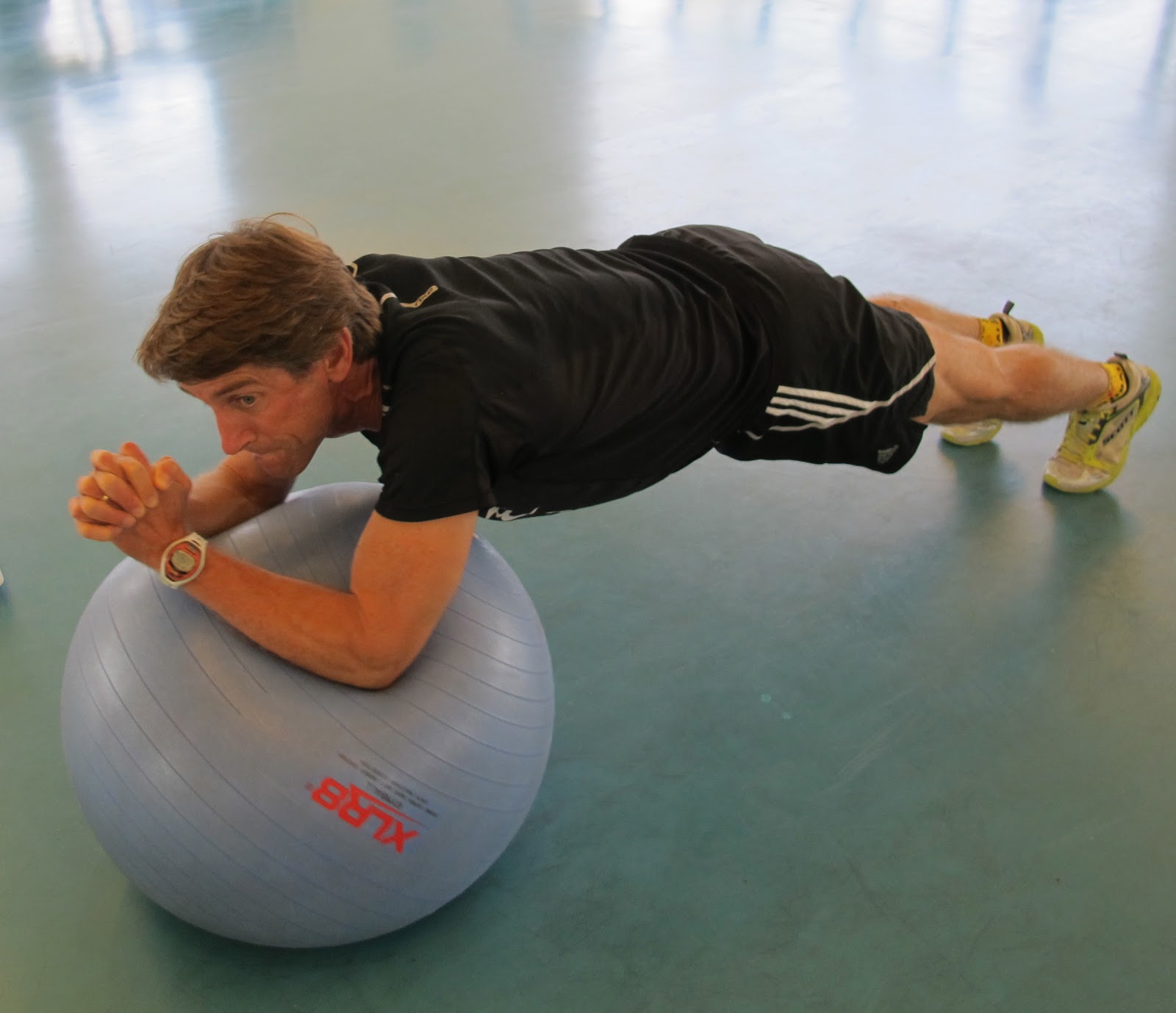
 This (right) is quite a difficult exercise and must be done carefully.  Here are the keys:
  • Don't let your butt drop below a slight elevation, as shown.
  • Place feet about a foot apart.
  • Rotate elbows in circular motion while keeping them in position shown. 
  • Exercise ball should be slightly under-inflated and not too big.
  • Keep breathing!
Strength comes from the core.  This is a good one.


This is a variation on the theme of the sideways plank, with a greater emphasis on balance.  Here is what to focus on:
  • Keep extended arm above the body and in the plane of the legs and lower arm.
  • Don't let the hips drop.
  • The weight-bearing upper arm needs to be perpendicular to your body.
  • Find your balance and get the body still before beginning your reps.


  • You can do a regular plank with upper leg resting on lower leg.
  • Or you can raise the upper leg a bit and create an isometric contraction, highlighting abductors.  
  • Best of all, this is a great way to gain range of motion and strength by raising and lowering upper leg through the full range.
  • I have ball rest against the wall, but if you're brave you can have ball be free...
  • Again, body position is important, so use mirrors or others' feedback to keep you honest.  
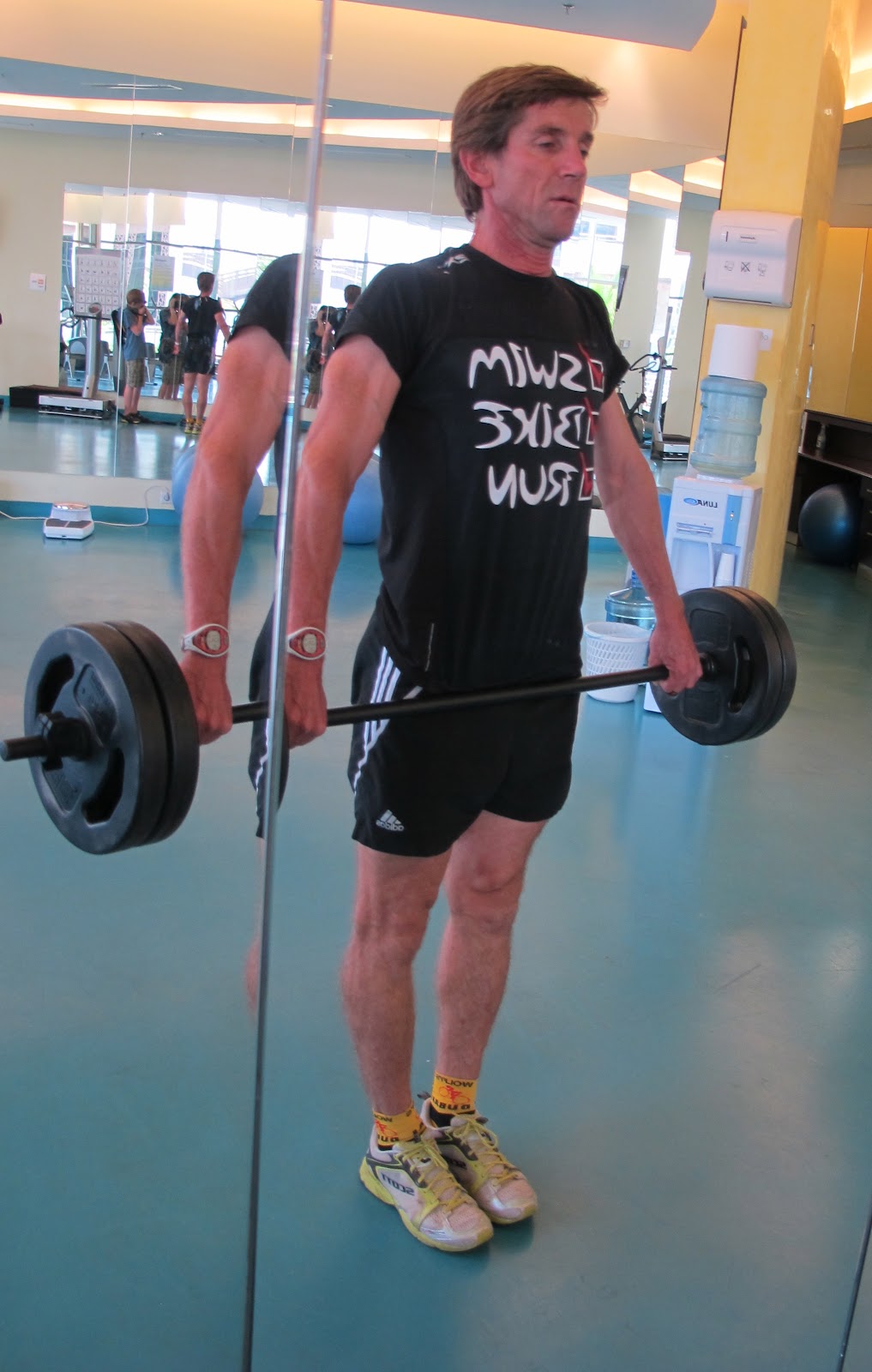
Bend at the hips, keep legs straight.
This one is my most recent addition.  It's a dead lift, with straight legs, that focuses on the legs of the back leg, particularly the upper hamstrings and gluts.  After a few hours of the bike leg's TT position this exercise helps maintain strength and power.